What happens when we make space for the parts of ourselves we leave at the door.
By Andine Sutarjadi, Managing Director
Three years ago, 21/64 was invited to explore a question that made my colleagues visibly uncomfortable.
What if inviting people to explore their spiritual identity could deepen how they understand themselves, lead others, and move resources toward lasting social change?
The question came from the Fetzer Institute, who challenged us to build on our work with ultra/high-net-wealth inheritors, multigenerational families, and the professionals who partner with them to steward resources and legacy.
For more than 20 years, we have guided leaders to explore the inherited and lived experiences that inform how they lead, govern, and make decisions so that multiple generations can work together more effectively. The Fetzer Institute’s invitation was to add one more dimension to that exploration: spiritual identity.
The invitation was not to teach religion or promote any particular belief system. It was far simpler, and, as it turned out, far more provocative. I was immediately intrigued. But the response from my team was more cautious. Would this feel too risky? Too personal? Too easily misunderstood?
At a time when organizations are working hard to create inclusive spaces, spirituality felt like dangerous territory. People might hear the word and immediately think religion, politics, or proselytizing. Some may feel unwelcome while others may feel judged.
Those concerns were legitimate. For many people, spirituality is inseparable from religious harm, colonialism, abuse, or extremism. For others, it simply feels too intimate to discuss outside their closest relationships.
Still, I couldn’t let go of the invitation.
Because the more I reflected on it, the more I realized that for millions of people, their earliest lessons about generosity did not begin at an annual fundraiser or board meeting. They began in churches, temples, mosques, synagogues, gurdwaras, and community gatherings. Long before individuals and families ever considered themselves donors, they learned about stewardship, service, gratitude, forgiveness, and repair through spiritual, religious, and ancestral traditions. I recognized that truth in my own life as well.
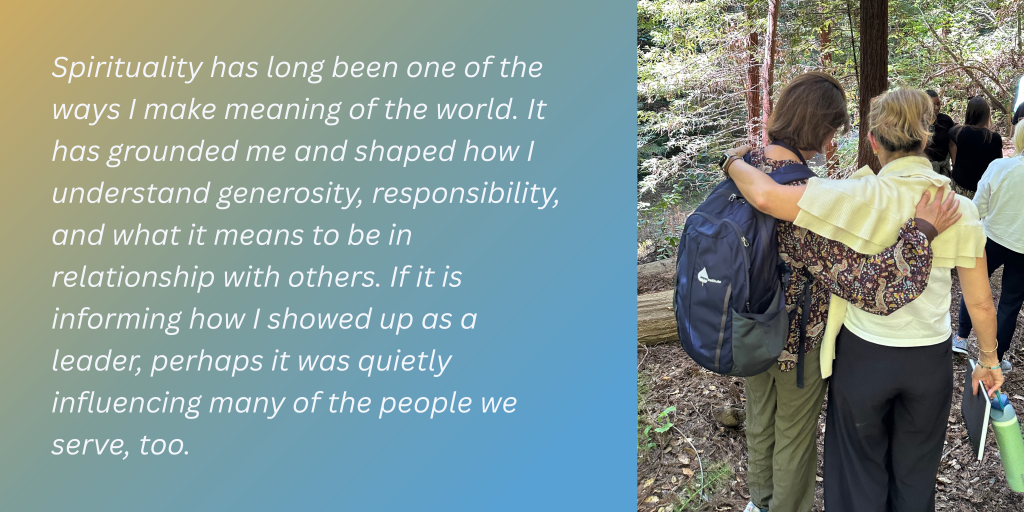
Spirituality has long been one of the ways I make meaning of the world. It has grounded me and shaped how I understand generosity, responsibility, and what it means to be in relationship with others. If it is informing how I showed up as a leader, perhaps it was quietly influencing many of the people we serve, too.
So we decided to accept the invitation.
Over the next three years, we interviewed practitioners, learned from scholars, experimented with new practices, and asked ourselves what it would take to create a space where people from many traditions, and people with no religious, spiritual, or ancestral tradition at all, could explore spirituality without anyone feeling pressured to believe, perform, or agree.
In May, we had the opportunity to pilot that work publicly. Beneath the towering redwoods of Northern California at 1440 Multiversity, we convened donors, advisors, family office leaders, and philanthropic professionals for a gathering called Exploring Self, Role and Spirit.
Over several days, participants reflected in silence, spent time in nature, moved and sang together, shared artifacts representing their cultural and ancestral traditions, and engaged in conversations that rarely happen in professional settings.
What grounds me? Who am I becoming? What am I afraid of? What kind of world am I helping and hoping to create?
People who arrived as strangers left describing themselves as a community. One participant told us:
“The way we lead, make decisions, steward resources, build relationships, and show up for communities is all connected to what grounds us spiritually and morally.”
Another wrote simply:
“We are all connected, and it is very easy to forget this.”
A third described the experience of people from profoundly different backgrounds engaging in shared spiritual practice as “the most politically subversive thing” they had ever experienced. That sentence has stayed with me. Not because anyone changed religions or because people reached consensus, but because they practiced something our culture desperately needs: making room for profound difference without asking anyone to leave a part of themselves at the door.
Many participants realized that spirituality had been quietly shaping their leadership all along. They drew connections between their deepest beliefs and how they approached stewardship, relationships, generosity, decision-making, and responsibility. These were not new convictions they discovered during the retreat. They were long-held sources of meaning that simply had never been invited into the room.
That feels especially significant today. Across sectors, leaders are wrestling with a growing crisis of loneliness, burnout, distrust and polarization. We often treat these as organizational challenges requiring better strategy, stronger management, or more effective communication. But perhaps they are also human challenges and ones that require us to return to questions we have always asked:
What gives life meaning? What do we owe one another? How do we cultivate resilience and hope in uncertain times?
Research also affirms what wisdom traditions have long explored. Psychologist Lisa Miller’s work on the awakened brain suggests that our capacity for meaning, awe, and transcendent connection is closely associated with resilience and wellbeing. Civil rights scholar john a. powell’s work on bridging reminds us that belonging does not come from erasing differences, but from learning how to remain connected across them.
And 21/64’s own longitudinal research with next generation donors has found that when inheritors of wealth are given sustained opportunities to reflect on identity, purpose and values within a trusted peer community, they lead differently, give differently, and engage their families and communities more effectively toward lasting social change. They told us their strategies change because they have experienced change within themselves.
After more than a decade of working with ultra/high-net-wealth donors, advisors, and leaders, I have come to believe that meaningful transformation rarely begins with a new theory of change, strategic plan or landscape analysis. It begins when people are given permission to examine the beliefs, experiences, relationships, and values that already inform how they move through the world.
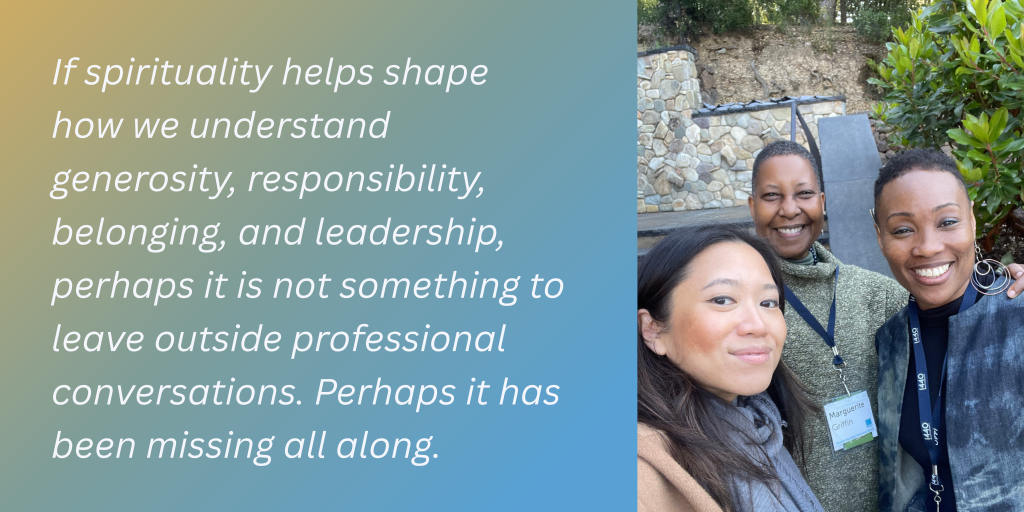
If spirituality helps shape how we understand generosity, responsibility, belonging, and leadership, perhaps it is not something to leave outside professional conversations. Perhaps it has been missing all along.
The question, for me, is no longer whether spirituality belongs in these conversations. Instead, I’m asking: What becomes possible when we intentionally make space for it? Because perhaps the future of leadership is not about becoming more strategic, influential, or powerful, but remembering how to become more human, together.
Andine Sutarjadi
Managing Director, 21/64